
What Is a Stock Index? Complete Guide for Beginners
A stock index is a statistical measure that tracks the performance of a group of stocks representing a specific market, sector, or economy. It helps investors understand overall market trends without analyzing individual stocks.
If you’ve ever heard phrases like “the market is up 500 points today”, that movement refers to a stock market index.
What Is a Stock Index?
A stock index is a measurement of the performance of a group of stocks that represent a specific part of the market.
In simple terms:
It shows how a group of companies is performing together.
For example, indices track top companies in a country or sector to give investors a quick overview of market trends.

What Is Index in Market?
When people ask what is index in market, they are referring to a benchmark that reflects the overall movement of the stock market.
Instead of tracking thousands of stocks individually, an index helps you understand:
- Market direction (up or down)
- Investor sentiment
- Economic trends
What Is an Index in Stocks?
The term what is an index in stocks means a collection of selected stocks grouped together based on criteria like:
- Market capitalization
- Industry sector
- Trading volume
These indices act as a reference point (benchmark) for investors and fund managers.
What Is Index in Stock Exchange?
A stock exchange index is created by stock exchanges to track the performance of listed companies.
Examples include:
- Nifty 50 (India)
- Sensex (India)
- S&P 500 (USA)
These indices help investors compare their portfolio performance with the market.
What Is a Point in Stock Market?
You may often hear terms like “market gained 200 points”.
So, what is a point in stock market?
A point represents a unit of change in the index value.
Example: If an index moves from 10,000 to 10,200 → it gained 200 points
This change reflects the overall performance of the stocks included in the index.
Types of Stock Market Indices
Type of Index | Description | Example | Key Benefit |
|---|---|---|---|
Benchmark Index | Represents the overall performance of the market using top companies | Nifty 50, Sensex | Tracks overall market health |
Sectoral Index | Focuses on specific industries like banking, IT, or pharma | Nifty Bank, Nifty IT | Helps analyze sector performance |
Market-Cap Index | Groups companies based on size (large-cap, mid-cap, small-cap) | Nifty Midcap 100 | Identifies growth opportunities |
Thematic Index | Tracks companies based on themes like ESG, technology, or infrastructure | Nifty ESG Index | Focuses on future trends |
Global Index | Represents international markets | S&P 500, Dow Jones | Enables global market comparison |
Broad Market Index | Covers a wide range of companies across sectors | NSE 500 | Provides diversified market view |
Understanding these types of stock indices helps investors choose the right strategy based on risk, sector focus, and investment goals.
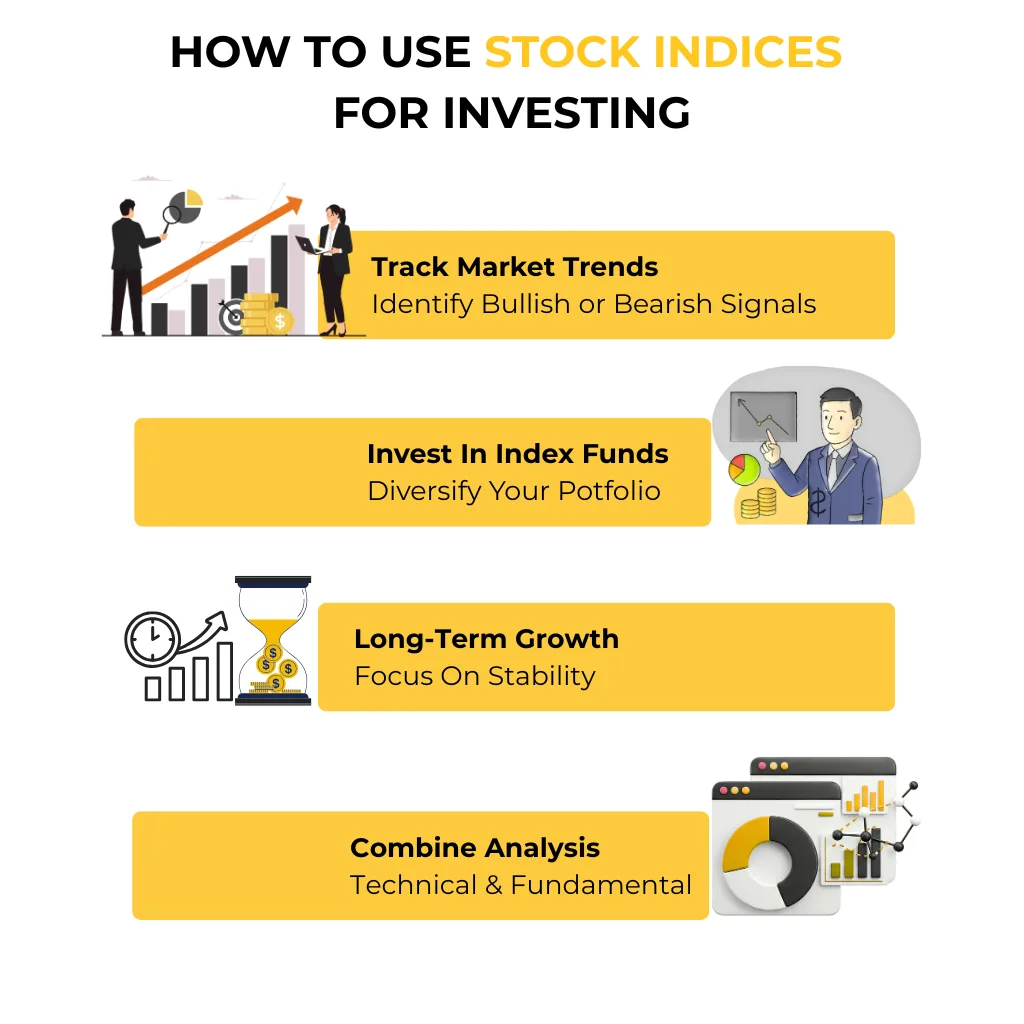
How to Use Stock Indices for Investing
Whether you are a trader or investor, understanding Stock Indices for Trading & Investing helps you make smarter financial decisions.
Why Are Stock Indices Important?
Stock indices play a crucial role for investors and traders:
- Market Indicator: Shows the overall health of the stock market
- Investment Benchmark: Helps compare your portfolio performance
- Passive Investing; Used in index funds and ETFs
- Economic Insight: Reflects economic growth and stability
How Stock Indices Are Calculated
Stock indices are calculated using different methods:
- Market-cap weighted (most common)
- Price-weighted
- Equal-weighted
Simple Example: If the overall value of companies in an index increases, the index rises — and vice versa.
Difference Between Stock Index and Individual Stock
Stock Index | Individual Stock |
| Represents multiple companies | Represents one company |
| Lower risk (diversified) | Higher risk |
| Used as benchmark | Used for direct investment |
Top Global Stock Indices You Should Know
Here are key indices every investor should be familiar with:
- Nifty 50 – Tracks top 50 companies in India
- Sensex – Tracks 30 major companies on BSE
- S&P 500 – Tracks 500 large US companies
- Dow Jones – One of the oldest US indices
Here's a quick look at what you'll read
A stock index measures the performance of a group of stocks, showing overall market trends.
They help track market direction, compare performance, and guide investment decisions
A point represents a change in index value (e.g., +100 points = market gain).
Yes, beginners can invest through index funds or ETFs.
Some popular ones include Nifty 50, Sensex, and S&P 500.
Wrapping Up
A stock index is one of the most powerful tools for understanding financial markets. It simplifies complex data, tracks overall performance, and helps investors make smarter decisions.
Whether you’re a beginner or an experienced investor, understanding stock indices is essential for long-term success in the market.
Ready to go beyond theory? Learn how to start investing in the stock market with expert guidance and build your portfolio the smart way.
