
What is Swing Trading? Key Concepts, Indicators, and Timeframes Explained
Swing trading is a popular trading style where traders hold a position for a few days to a few weeks to capture short- to medium-term price movements. It is different from day trading, where trades are opened and closed on the same day, and different from long-term investing, where positions may be held for months or years.
In simple words, swing trading means identifying a possible price “swing” in stocks, forex, commodities, or crypto and entering the trade with a clear target and stop loss. Many beginners also use swing trading signals to identify possible entries and exits with expert support.. However, it still needs proper planning, risk management, and discipline.
In this guide, you will learn the meaning of swing trading, how swing traders work, the best indicators, useful timeframes, common strategies, and whether swing trading is good for beginners.
What is Swing Trading?
Swing trading is a trading method where traders try to profit from price movements that happen over several days or weeks. These price movements are called swings.
For example, if a stock is trading near support and a trader expects it to move higher, they may buy the stock and hold it until the price reaches the next resistance level. Similarly, in forex or gold trading, a swing trader may enter after a breakout, pullback, or trend confirmation.

The main goal of swing trading is to enter at the right level, hold the trade during the expected move, and exit before the trend becomes weak.
Who is a Swing Trader?
A swing trader is someone who looks for short- to medium-term trading opportunities using technical analysis, chart patterns, market trends, and indicators.
Swing traders usually do not take multiple trades every hour like scalpers. They also do not hold trades for very long periods like investors. Instead, they wait for quality setups and hold trades for a few days or weeks.
This makes swing trading suitable for part-time traders, beginners, and people who want to trade with a planned approach.
How Does Swing Trading Work?
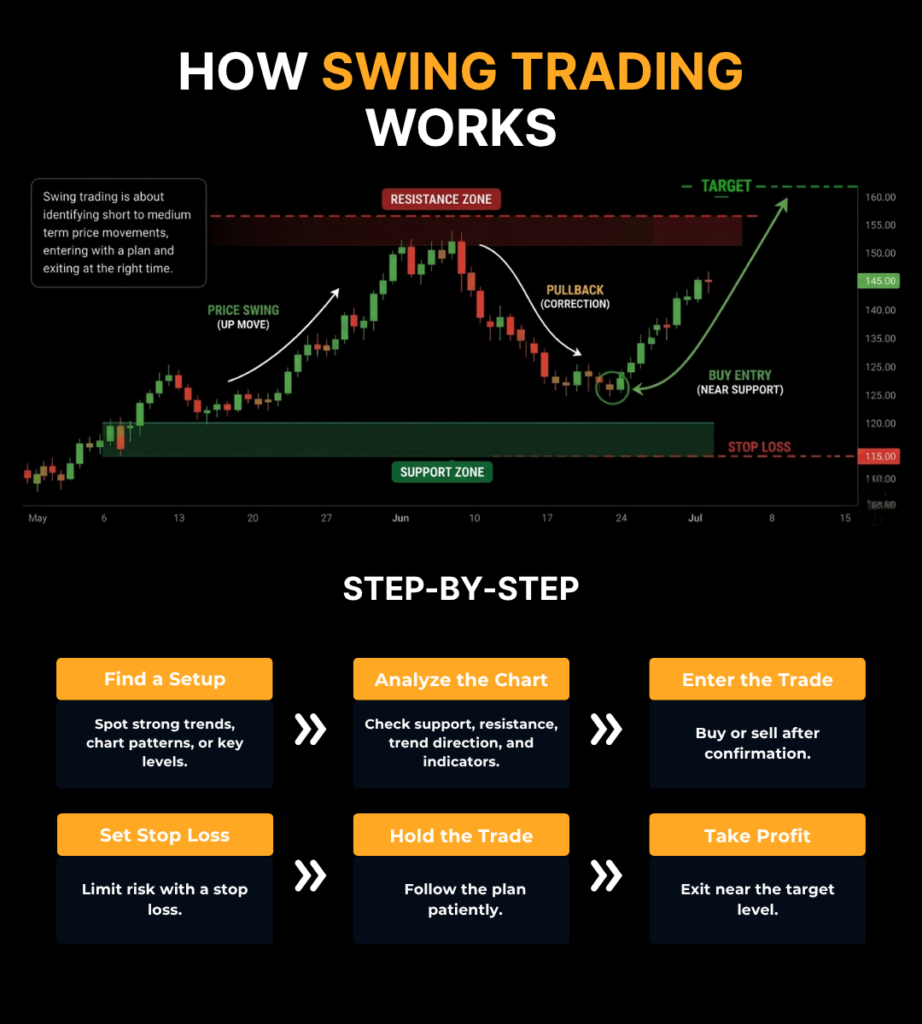
Swing trading works by identifying a possible price movement before it happens. Traders usually follow these steps:
First, they find an asset with good movement, volume, and trend. Then, they study the chart to identify support, resistance, trendlines, or breakout levels. After that, they wait for confirmation from indicators or price action. Once the setup looks strong, they enter the trade with a clear stop loss and target.
For example, if a stock is moving in an uptrend and pulls back near a moving average, a swing trader may look for a buying opportunity. If the price shows a bullish candle near support, the trader may enter the trade and target the previous high or next resistance level.
The most important part of swing trading is not just finding entries. It is managing risk. Every trade should have a stop loss, target, and risk-reward plan.
Best Timeframes for Swing Trading
Timeframe selection is very important in swing trading. If the timeframe is too small, traders may get trapped in market noise. If it is too large, entries may come too late.
The most commonly used timeframes for swing trading are:
Timeframe | Best Use |
1-hour chart | Short-term entry confirmation |
4-hour chart | Stronger setup confirmation |
Daily chart | Main trend and swing direction |
Weekly chart | Bigger market structur |
For beginners, the daily chart and 4-hour chart are usually better because they provide cleaner signals. The 1-hour chart can be used for entry timing, but traders should not depend only on very small timeframes.
Best Indicators for Swing Trading
Swing traders use indicators to confirm trends, momentum, and possible entry points. However, using too many indicators can create confusion. It is better to use a few simple indicators properly.
1. Moving Averages
Moving averages help traders identify the trend direction. If the price is above the moving average, the trend may be bullish. If the price is below it, the trend may be bearish.
Common moving averages used by swing traders include the 20-day, 50-day, and 200-day moving averages.
2. RSI
The Relative Strength Index, or RSI, helps identify overbought and oversold conditions. If RSI is above 70, the asset may be overbought. If RSI is below 30, it may be oversold.
Swing traders often use RSI with support and resistance for better confirmation.
3. MACD
MACD is used to identify momentum and trend changes. A bullish crossover can show buying momentum, while a bearish crossover can show selling pressure
4. Bollinger Bands
Bollinger Bands help traders understand volatility. When the price touches the lower band near support, traders may look for buying opportunities. When it touches the upper band near resistance, traders may consider booking profit.
5. Fibonacci Retracement
Fibonacci levels are useful for finding pullback zones. Many swing traders look for entries near 38.2%, 50%, or 61.8% retracement levels.
Popular Swing Trading Strategies
There are many swing trading strategies, but beginners should focus on simple and clear setups.
1. Trend Following Strategy
In this strategy, traders follow the existing trend. If the market is making higher highs and higher lows, traders look for buying opportunities. If the market is making lower highs and lower lows, traders look for selling opportunities.
2. Breakout Strategy
A breakout happens when the price moves above resistance or below support. Swing traders enter after the breakout and look for continuation. This strategy works well when supported by strong volume.
3. Pullback Strategy
In a pullback strategy, traders wait for the price to come back to a support level, moving average, or Fibonacci zone before entering. This allows traders to enter at a better price instead of chasing the market.
4. Reversal Strategy
A reversal strategy is used when traders expect the market direction to change. For example, if a stock has fallen sharply and forms a bullish reversal pattern near support, a trader may enter for a short-term bounce.
5. Range Trading Strategy
When the market moves sideways between support and resistance, swing traders may buy near support and sell near resistance.
Swing Trading Stocks: How to Pick the Right Ones
Not every stock is good for swing trading. The best swing trading stocks usually have good volume, strong price movement, clear chart structure, and visible support and resistance levels.
A good swing trading stock should have:
- Strong liquidity
- Good trading volume
- Clear trend
- Price volatility
- Clean support and resistance levels
- Sector or news momentum
Traders should avoid stocks with very low volume because they can be difficult to enter and exit.
Example of a Swing Trade Setup
Here is a simple example of how a swing trade may look:
Element | Example |
Asset | Stock, forex pair, gold, or crypto |
Trend | Uptrend |
Entry | Near support or breakout |
Stop Loss | Below support |
Target | Next resistance level |
Timeframe | Daily + 4-hour chart |
Risk | 1–2% of capital |
This type of setup helps traders plan before entering the trade. The goal is not to guess the market but to trade with a clear entry, stop loss, and target.
Scalp Trading vs Swing Trading
Scalping and swing trading are very different.
Factor | Scalping | Swing Trading |
Holding Period | Seconds to minutes | Days to weeks |
Screen Time | Very high | Moderate |
Trade Frequency | High | Medium |
Stress Level | High | Medium |
Best For | Full-time active traders | Part-time traders |
Scalping may give quick opportunities, but it requires fast decisions and constant attention. Swing trading is more suitable for traders who want fewer trades and better planning time.
Position Trading vs Swing Trading
Position trading is longer-term than swing trading. A position trader may hold trades for weeks, months, or even years. A swing trader usually exits within a few days or weeks.
Swing trading is better for traders who want active opportunities, while position trading is better for traders who prefer long-term market trends.
Can You Swing Trade Options?
Yes, options can be used for swing trading, but they are risky. Options have expiry dates, premium changes, and time decay. Even if the market direction is correct, the option value can still fall due to time decay.
Beginners should understand strike price, expiry, premium, and risk before swing trading options.
Is Swing Trading Good for Beginners?
Yes, swing trading can be good for beginners because it gives more time to analyze trades compared to day trading vs swing trading. Beginners do not need to watch charts every minute.
However, beginners should start with small risk, use stop loss, avoid high leverage, and follow a written trading plan. The goal should be learning consistency first, not making quick profits.
Common Mistakes Swing Traders Make
Many beginners lose money in swing trading because they make simple mistakes. Common mistakes include:
- Entering without confirmation
- Ignoring stop loss
- Using too much leverage
- Trading low-volume stocks
- Holding losing trades too long
- Using too many indicators
- Risking too much on one trade
- Exiting too early due to fear
The best way to avoid these mistakes is to follow a proper trading plan and risk only a small percentage of capital on each trade.
Wrapping Up
Swing trading is a useful trading style for people who want to capture short- to medium-term price movements without watching charts all day. It can be used in stocks, forex, commodities, and crypto.
The key to successful swing trading is choosing the right asset, using proper timeframes, following simple indicators, and managing risk carefully. Whether you are a beginner or an active trader, swing trading should always be done with patience, discipline, and a clear plan.
Need expert help finding trading opportunities? Contact Carlos & Company and get professional market guidance for smarter trading decisions.
Here's a quick look at what you'll read
Accordion CSwing trading is a trading style where traders hold positions for a few days to a few weeks to capture short- to medium-term price movements.ontent
A swing trader is a trader who uses charts, indicators, and market trends to find short- to medium-term trading opportunities.
The daily and 4-hour charts are commonly used for swing trading because they give cleaner signals and better trend confirmation.
Swing trading is better for traders who cannot watch charts all day, while scalping is suitable for highly active traders.
Moving averages, RSI, MACD, Bollinger Bands, Fibonacci retracement, and support/resistance are commonly used.
The best swing trading stocks usually have strong volume, clear trends, volatility, and clean support/resistance levels.
Swing trading means holding trades for a few days to a few weeks, while day trading means opening and closing trades on the same day.
Swing trading needs less screen time and gives traders more time to plan. Day trading needs fast decisions, constant chart watching, and more active trade management.
| Factor | Swing Trading | Day Trading |
|---|---|---|
| Holding period | Few days to few weeks | Same trading day |
| Screen time | Moderate | High |
| Trade frequency | Lower | Higher |
| Stress level | Medium | High |
| Best for | Part-time traders and beginners | Full-time active traders |
| Overnight risk | Yes | No |
| Analysis style | Daily/4-hour charts | 5-minute/15-minute/1-hour charts |
