
What are forex trading signals & how to use them effectively?
Forex trading signals are buy or sell alerts that help traders identify potential trading opportunities in the foreign exchange market. A forex signal typically includes a currency pair, entry price, stop-loss level, take-profit target and trade direction.
Also known as FX signals or currency trading signals, these alerts are generated through technical analysis, fundamental research or automated trading systems. They can help traders evaluate market opportunities, but no forex signal can guarantee a profitable trade.
Whether you’re a beginner learning about currency trading or an experienced trader exploring signal services, understanding how these alerts work is essential.
In this guide, you’ll learn what forex trading signals are, how to read and create them, the types of signals available, their benefits and risks, and how to evaluate a forex signal provider.
What are Forex Trading Signals?
Forex trading signals are market alerts that suggest potential opportunities to buy or sell currency pairs such as EUR/USD, GBP/USD or USD/JPY.
A forex trade signal is generally generated when market conditions meet specific trading criteria. These criteria may include price action, technical indicators, support and resistance levels, economic news or market trends.

For example, a forex analyst may identify an opportunity to buy EUR/USD when the currency pair breaks above resistance and shows upward momentum.
A complete forex trading signal usually contains the following information:
| Signal Component | Meaning |
|---|---|
| Currency Pair | The currencies being traded, such as EUR/USD |
| Signal Type | Buy or sell recommendation |
| Entry Price | Suggested price for opening the trade |
| Stop-Loss | Price level intended to limit potential losses |
| Take-Profit | Target price for closing the trade |
| Timeframe | Expected trading period or chart interval |
| Market Analysis | Reasoning behind the trading opportunity |
Forex signals are not limited to beginners. Experienced traders may use them as an additional source of market research, although every signal should be evaluated independently.
How Do Forex Trading Signals Work?
Forex trading signals work by converting market analysis into structured trading alerts.
Signal providers study currency-price movements, identify possible market opportunities and share the resulting trade information with subscribers.
The process typically involves five steps.
1. Analyzing Forex Market Conditions
Analysts and trading systems monitor currency pairs to identify potential trends, reversals and breakouts.
Common analytical tools include:
Moving averages
Relative Strength Index (RSI)
Moving Average Convergence Divergence (MACD)
Support and resistance
Candlestick patterns
Economic calendars
Interest-rate announcements
These tools help identify possible trading conditions but cannot predict future movements with certainty.
2. Identifying Buy or Sell Opportunities
When a potential setup appears, the analyst determines whether the trading strategy indicates a buying or selling opportunity.
For example, if GBP/USD breaks below an important support level, an analyst may investigate a potential sell setup.
The conditions used to identify these opportunities depend on the analyst’s forex trading strategy, including entry rules, market conditions, and risk-management criteria.
3. Preparing the Currency Signal
The provider creates an alert with the relevant trade information.
This generally includes the currency pair, trade direction, entry price, stop-loss and take-profit levels.
4. Sending the Forex Signal
Trading alerts may be delivered through:
Telegram forex signal channels
WhatsApp notifications
Email alerts
Mobile trading applications
MetaTrader-compatible signal services
Some providers offer free alerts, while others include additional research and support through forex signal membership services.
5. Evaluating and Executing the Trade
After receiving an alert, traders evaluate the trading conditions and decide whether the setup is suitable.
Trades may be executed manually or through compatible automated systems.
Execution prices can differ from the original alert because of spreads, market volatility, slippage and delays.
How to Read Forex Trading Signals: Practical Example
Understanding the components of a forex signal is important before placing a trade.
Consider this hypothetical EUR/USD trading alert.
Example of a Forex Buy Signal
| Trading Signal | Example |
|---|---|
| Currency Pair | EUR/USD |
| Signal Direction | Buy |
| Entry Price | 1.1000 |
| Stop-Loss | 1.0950 |
| Take-Profit | 1.1100 |
| Risk | 50 pips |
| Potential Reward | 100 pips |
| Risk-to-Reward Ratio | 1:2 |
This example is hypothetical and is not a live trading recommendation.
How Does This Buy Signal Work?
The alert suggests buying EUR/USD at 1.1000 because the underlying analysis indicates a potential upward movement.
If the price reaches 1.1100, the trade would achieve its planned target of 100 pips.
If the price falls to 1.0950, the stop-loss is intended to limit the planned price movement against the position to 50 pips.
The planned risk-to-reward ratio is 1:2.
This means the potential reward is twice the initial price risk, before trading costs.
However, spreads, slippage and market gaps can affect execution, and a stop-loss order does not guarantee closure at the exact specified price.
How to Read a Forex Sell Signal
A sell signal works in the opposite direction.
For example, a hypothetical GBP/USD sell alert might include:
Entry: 1.2800
Stop-loss: 1.2850
Take-profit: 1.2700
In this example, the trade idea anticipates a decline in GBP/USD.
The stop-loss is positioned above the entry, while the take-profit is positioned below it.
Before following any forex signal, traders should understand the trade direction, invalidation level, potential reward and execution risks.
Types of Forex Trading Signals
Forex signals are generally categorized according to how they are generated and how traders use them.
1. Manual Forex Trading Signals
Manual forex signals are created by traders or market analysts using their interpretation of price movements, indicators and economic events.
Analysts may study market trends, support and resistance levels, candlestick patterns and fundamental developments before issuing alerts.
Potential advantages:
Analysts can consider changing economic conditions.
Signals may include additional market commentary.
Human judgment can account for unusual market events.
Limitations:
Analysis may be affected by individual bias.
Signal quality depends on the analyst’s methodology.
Human monitoring and delivery can introduce delays.
2. Automated Forex Trading Signals
Automated signals are generated using algorithms or software based on predefined trading conditions.
For example, a system may issue a buy signal when specific moving averages cross and an additional momentum condition is met.
Potential advantages:
Trading rules can be applied consistently.
Systems can monitor multiple markets automatically.
Automated analysis can reduce some discretionary decision-making.
Limitations:
Algorithms may perform poorly when market conditions change.
Backtested results may not reflect live trading performance.
Technical errors and execution problems can affect outcomes.
Neither manual nor automated signals are automatically more profitable.
3. Technical Forex Signals
Technical signals are generated using price charts, indicators, trading volume where available, trendlines and chart patterns.
For example, an analyst may identify a possible buy opportunity when a currency pair breaks above resistance.
4. Fundamental Forex Signals
Fundamental signals are based on economic and financial developments that may affect currency values.
Important factors include:
Central bank interest-rate decisions
Inflation reports
Employment data
Gross domestic product
Geopolitical events
Monetary policy expectations
Some providers offer free alerts, while others include additional research and support through forex signal membership services.
Who Provides Forex Trading Signals?
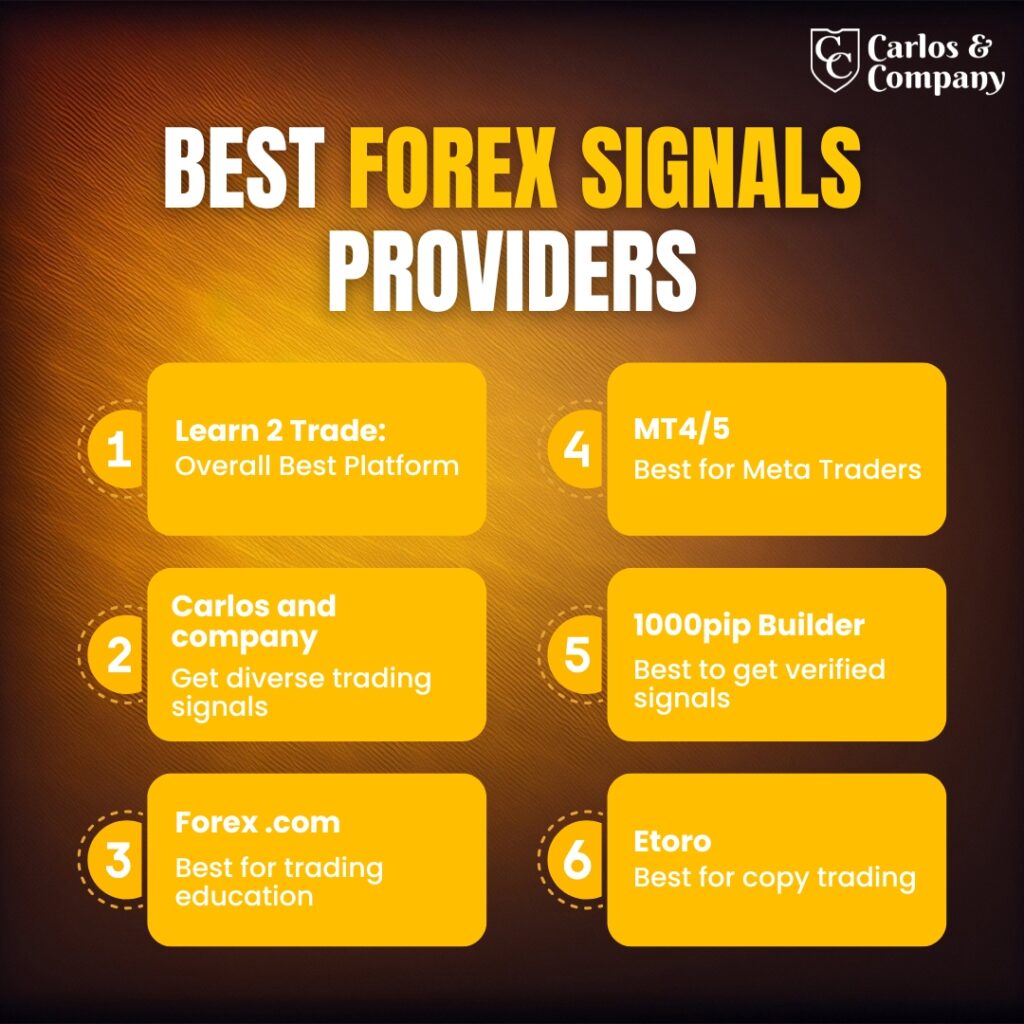
Forex trading signals can be generated or distributed by independent market analysts, trading research companies, signal-service platforms, brokers and automated systems.
Different providers may specialize in different currency pairs, timeframes or trading strategies.
Before selecting a service, traders should understand the difference between a forex signal provider, a broker and a copy trading platform.
| Service | Primary Function |
|---|---|
| Forex Signal Provider | Shares potential buy and sell opportunities |
| Forex Broker | Provides market access and executes orders |
| Copy Trading Platform | May automatically replicate another trader’s positions |
| Trading Research Service | Provides market commentary, analysis and educational information |
Some companies offer more than one service, but they should explain these offerings clearly.
Choosing among forex signal providers requires evaluating performance transparency, analytical methods, risk-management practices, and service terms rather than relying on advertised success rates.
How to Create Your Own Forex Trading Signals
Traders can develop their own forex signals by using a structured approach to market analysis and risk management.
Step 1: Choose a Currency Pair
Start by selecting a currency pair you want to monitor.
Common examples include EUR/USD, GBP/USD and USD/JPY.
Studying a small number of markets may help beginners become more familiar with their price movements.
Step 2: Select a Trading Timeframe
Different trading strategies use different timeframes.
Short-term traders may analyze five-minute or fifteen-minute charts, while swing traders may focus on four-hour or daily charts.
The timeframe should align with the trader’s strategy and availability.
Step 3: Develop a Trading Strategy
Create a set of conditions for entering and exiting trades.
For example, a strategy might look for:
An established upward trend
A pullback toward a support area
Bullish price confirmation
A defined stop-loss level
A reasonable risk-to-reward ratio
The strategy should specify what conditions must be satisfied before a signal is generated.
Step 4: Analyze Market Conditions
Use technical and fundamental information to evaluate the potential opportunity.
Check whether important economic announcements or unexpected market events could affect the selected currency pair.
Step 5: Define Entry, Stop-Loss and Take-Profit
A trading signal should include a potential entry level, an invalidation point and a target.
These levels should be based on the strategy rather than chosen arbitrarily.
Step 6: Backtest and Practice
Before using a strategy with real money, test it against historical data and observe its performance under simulated market conditions.
Record winning trades, losing trades, drawdowns and trading costs.
Remember that historical testing cannot guarantee future results.
What Is the Best Time to Trade Forex Trading Signals?
The foreign exchange market is generally available for trading around the clock during the working week, although trading hours depend on the instrument, broker and holidays.
The major forex trading sessions are Sydney, Tokyo, London and New York.
For many major currency pairs, the London and New York sessions are important because trading activity can be relatively high.
The London–New York overlap may offer active market conditions, but it can also involve sharp movements during economic news releases.
Traders in the UK, Europe and Gulf countries should consider local time zones, daylight saving changes and the currency pairs they trade.
There is no single trading session that guarantees better results.
Understanding when the forex market opens helps traders identify session overlaps and plan their market analysis around suitable trading hours.
Benefits of Forex Trading Signals
Forex signals can provide useful information when incorporated into a disciplined trading process.
1. Save Time on Market Research
Signals may reduce the time needed to search for possible opportunities across multiple currency pairs.
However, traders still need to evaluate the information before making decisions.
2. Provide Structured Trading Information
A complete signal contains potential entry, stop-loss and take-profit levels.
These details help traders understand the intended setup and its potential risks.
3. Support Learning and Market Analysis
Educational signals may help beginners understand market trends, chart patterns and trading strategies.
The greatest learning value generally comes from understanding why a signal was generated.
4. Improve Trading Preparation
Signals can encourage traders to consider potential exits and risk before entering positions.
However, following signals does not automatically improve risk management or profitability.
Risks and Disadvantages of Forex Trading Signals
Forex signals also have limitations that traders should understand.
- Incorrect market predictions: Even carefully researched trade ideas can fail.
- Slippage and execution costs: Actual results may differ from the provider’s suggested prices.
- Unverified results: Some providers advertise winning trades while omitting losses.
- Excessive leverage: Using large leveraged positions can increase potential losses.
- Over-reliance: Following signals without independent analysis can lead to unsuitable trades.
- Subscription costs: Paid signal fees reduce overall net returns and may not offer sufficient value.
Trading signals should be treated as research inputs rather than guaranteed instructions.
Are Forex Trading Signals Reliable?
Forex trading signals vary in reliability depending on the strategy, provider, market conditions and execution quality.
A provider’s advertised success rate alone is not sufficient to judge performance.
Instead, examine the following measures.
Win Rate
Win rate measures the proportion of trades that finish profitably.
However, a strategy can have a high win rate and still lose money if its average losses are substantially larger than its average gains.
Risk-to-Reward Ratio
Risk-to-reward compares the planned potential gain against the planned potential loss.
For example, a 1:2 ratio indicates a potential reward twice the initial price risk.
The ratio does not tell traders how often the target will be reached.
Maximum Drawdown
Drawdown measures the decline in account or strategy value from a previous peak.
This helps traders understand the severity of historical losing periods.
Trading Expectancy
Trading expectancy measures the average anticipated result of a trading strategy based on its historical win rate and average winning and losing trades.
Consider this hypothetical example:
| Performance Metric | Example |
|---|---|
| Winning Trade Rate | 40% |
| Losing Trade Rate | 60% |
| Average Winning Trade | $200 |
| Average Losing Trade | $100 |
| Expectancy Before Costs | +$20 per trade |
The calculation is:
(0.40 × $200) − (0.60 × $100) = $20.
This illustrates how a strategy can have positive expectancy despite losing more trades than it wins.
However, actual performance depends on the sample size, market conditions, trading costs and execution. Past performance does not guarantee future results.
Free vs Paid Forex Signals: Which Should You Choose?
Free and paid forex signals differ in pricing, access and service features, but neither category guarantees accuracy.
| Feature | Free Forex Signals | Paid Forex Signals |
|---|---|---|
| Cost | Usually free | Subscription or service charge |
| Signal Access | Varies | Depends on package |
| Market Commentary | May be limited | May include additional analysis |
| Customer Support | Varies by provider | May include dedicated support |
| Performance Verification | Must be checked | Must be checked |
| Guaranteed Profits | No | No |
A paid forex signal service should not be assumed to be better simply because it charges a fee.
Before paying, review the provider’s methodology, historical performance, trading costs and cancellation terms.
Conclusion
Understanding what forex trading signals are helps traders evaluate market alerts and potential currency-trading opportunities more effectively.
Forex signals provide structured buy and sell information based on technical analysis, fundamental research, and automated trading strategies. However, these alerts cannot eliminate market uncertainty or guarantee profits.
Whether using manual, automated, free, or paid forex signals, traders should prioritize risk management, performance transparency, and independent market analysis.
At Carlos & Company, forex signal membership services form part of the company’s broader market-research and trading-education offering. Understanding the methodology, service terms, and potential risks is essential before making trading decisions.
Here's a quick look at what you'll read
There is no universally best forex signal. Traders should evaluate a provider’s methodology, historical performance, risk-management approach, and service suitability.
Accuracy varies depending on the strategy, provider, market conditions, and execution. No provider can guarantee a particular success rate or consistently profitable outcomes.
Various Forex companies provide paid and free forex signals to traders.
Forex signals are alerts that identify potential buying or selling opportunities in currency pairs. They typically include a suggested entry price, stop-loss level, and take-profit target.
Forex signals are generated through technical analysis, fundamental research, or automated trading systems. The resulting alerts communicate potential trading setups and relevant price levels.

